
By Aliyah Saifuddin, PhD
I joined CWB at a time when I was lacking in fulfilment and a sense of community. I had spent years doing science, thinking about hypothetical beneficiaries, as if they were figments of my imagination, and there to answer the age-old question of “where does this work fit into the big picture”. I was tired of imagining these communities and the impact, and ready to dive in and make direct, meaningful change, particularly at a time of global unrest, where many of us sat in safety, felt pretty helpless. When doing science at the bench, or analysing data on the screen and drawing conclusions, the world felt small and I felt narrow minded; and I was desperate to escape this mindset to see the bigger picture, and work alongside communities where innovation was needed the most, and realise the true impact of science, rather than the much surveyed, relatively superficial metric of journal impact factor, often used to rank contributions to the scientific community. I have been interested in the applications of science, particularly to ease societal problems for some time, and it was reignited shortly after starting my PhD and learning about solid phase extraction. I began to wonder if it could be used to alleviate water poverty, and from this point, my curiosity grew.
I had my first call with Ramin Sedehi, the President and CEO, and sheepishly put my camera on after a couple of minutes, and immediately felt at ease. Discussion of science improving lives, and the United Nations Sustainability Development Goals felt natural and not forced, we were on the same page, and I finally felt at home.
Here at CWB we work with communities to maximise positive, sustainable impacts. We appreciate that the scientific innovation we want to implement cannot be seen as a “black box” that we take from community to community. Whilst some translation is possible, our unique approach comes from how we adapt our practice to meet the community, taking into account the local religion, culture and environment, and treating the local partners and population with kindness, respect, dignity and empathy. Scientists often have the stereotype of lacking interpersonal skills, which is unfortunate, as normally they are motivated by making discoveries to help people – be this through advances in medicine, diagnostics, innovations in environmental applications such as renewable energy or water access technologies, or agriculture, to name a few. At CWB, people come first; science comes second, and is used as a tool to help the people.
To me, “Chemists Without Borders” conjures up the image of chemistry being implemented beyond the confines of the laboratory, even if settings are not as resource rich as the laboratory may be. It is chemistry without limits. The absence of these limits and borders also enables us as a chemist community to cross social, geographical, economical and environmental borders, and use science as a vehicle to help others, improve qualities of life, and move towards a more sustainable future.
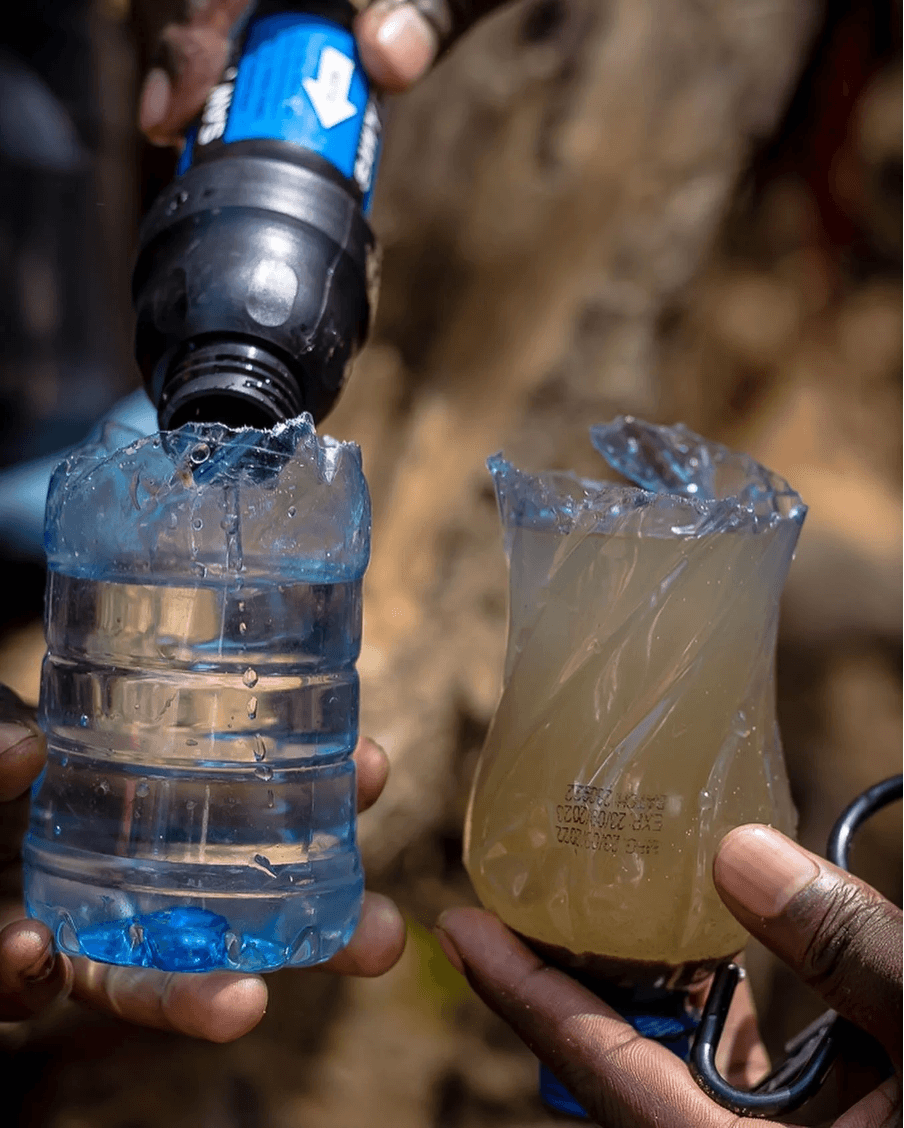
Image credit: https://www.opblue.org/opwater